Placing a TV branding campaign in Germany involves navigating a highly structured market divided neatly between major private networks, public broadcasters, and a booming Connected TV (CTV) landscape. Because you are looking at this from an automotive context, targeting the right demographics and using the precise terminology of the German TV landscape is critical.
Here is the step-by-step process for executing a TV branding campaign in Germany.
Step 1: Choose Your TV Channels (The Network Landscape)
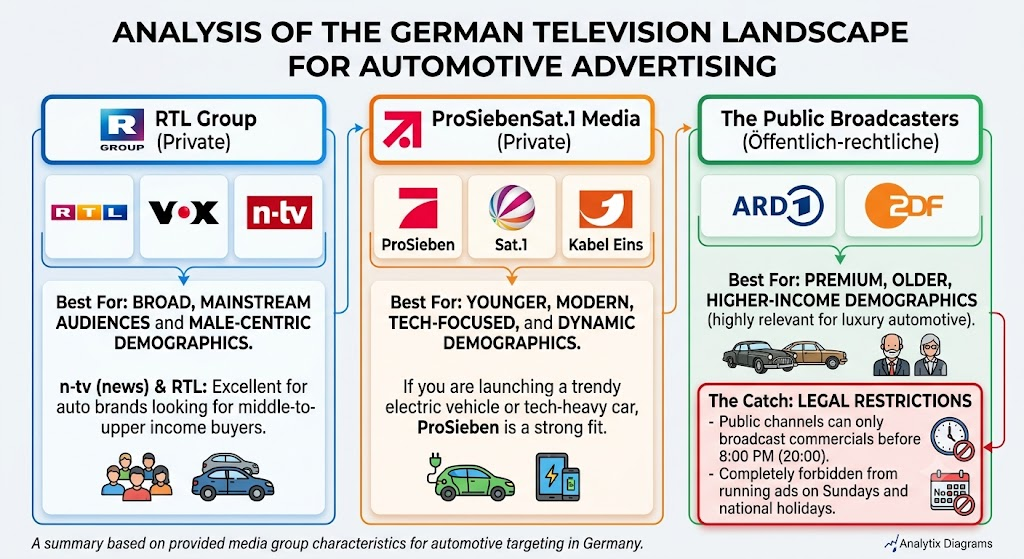
The German television market is consolidated into three major blocks. For an automotive brand, your audience will dictate which block you choose:
- The RTL Group (Private): Channels include RTL, VOX, and n-tv.
- Best for: Broad, mainstream audiences and male-centric demographics. n-tv (news) and RTL are excellent for auto brands looking for middle-to-upper income buyers.
- ProSiebenSat.1 Media (Private): Channels include ProSieben, Sat.1, and Kabel Eins.
- Best for: Younger, modern, tech-focused, and dynamic demographics. If you are launching a trendy electric vehicle or tech-heavy car, ProSieben is a strong fit.
- The Public Broadcasters (Öffentlich-rechtliche):ARD and ZDF.
- Best for: Premium, older, higher-income demographics (highly relevant for luxury automotive).
- The Catch: By German law, public channels can only broadcast commercials before 8:00 PM (20:00) and are completely forbidden from running ads on Sundays and national holidays.
Step 2: Use the Right Advertising Marketers (Platforms)
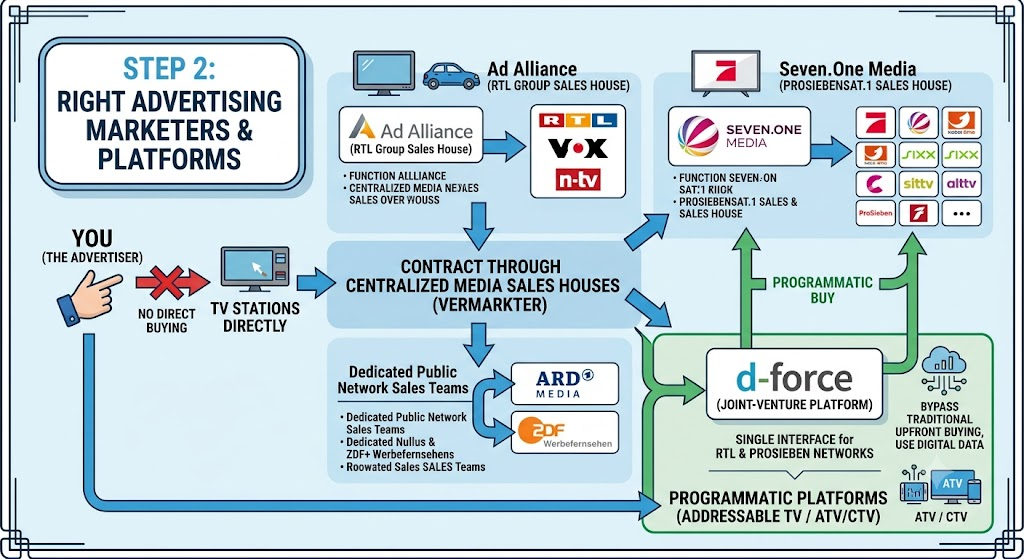
You do not buy ads directly from the TV stations themselves. Instead, you contract through centralized media sales houses (Vermarkter). You can buy traditional linear spots or use programmatic platforms for Addressable TV (ATV/CTV):
- Ad Alliance: This is the sales house for the RTL Group. If you want to buy ads on RTL, VOX, or n-tv, this is who you deal with.
- Seven.One Media: The sales house for all ProSiebenSat.1 channels.
- ARD MEDIA & ZDF Werbefernsehen: The dedicated sales teams for the public networks.
- d-force: If you want to bypass traditional upfront buying and run Addressable TV (ATV) using digital data, d-force is a major joint-venture platform in Germany that lets you programmatically buy ad space across both RTL and ProSieben networks using a single interface.
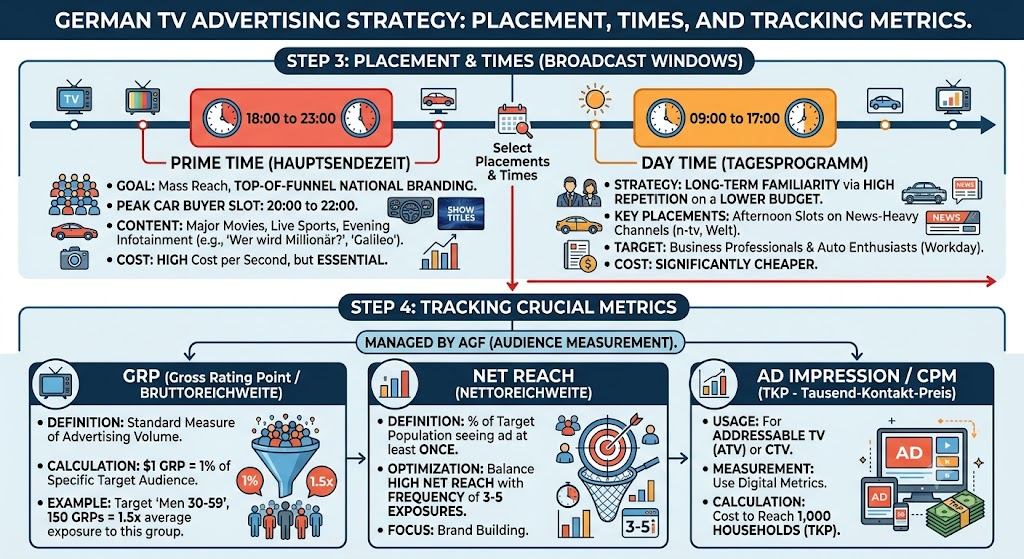
Step 3: Select Your Placements and Times (The Broadcast Windows)
German TV rates are heavily tied to the time of day, categorized into two main windows:
Prime Time (Hauptsendezeit): 18:00 to 23:00
This is where you get mass reach. The absolute peak for car buyers is 20:00 to 22:00, specifically during major movies, live sports, or popular evening infotainment shows (like Wer wird Millionär? on RTL or Galileo on ProSieben).
- Cost: High cost per second, but essential for top-of-funnel national branding.
Day Time (Tagesprogramm): 09:00 to 17:00
Significantly cheaper.
- Strategy: If you are looking to run highly repetitive ads to build long-term familiarity on a lower budget, afternoon slots on news-heavy channels like n-tv or Welt catch business professionals and auto enthusiasts during the workday.
Step 4: Track the Crucial Metrics
Unlike digital PPC where you track clicks and instant CPAs, German TV branding relies on specific audience measurement metrics managed by AGF (the organization that tracks German TV viewing figures).
- GRP (Gross Rating Point / Bruttoreichweite): The standard measure of advertising volume. $1\text{ GRP} = 1\%$ of your specific target audience. If your target is “Men aged 30-59” and your ad achieves 150 GRPs, you’ve theoretically exposed that demographic to your ad 1.5 times on average.
- Net Reach (Nettoreichweite): The percentage of the target population that saw your ad at least once. For branding, you want to optimize for a balance of high net reach and a Frequency (Kontakte) of 3 to 5 exposures.
- Ad Impression / CPM (TKP – Tausend-Kontakt-Preis): If you opt for Addressable TV or CTV, you will measure performance using digital metrics—specifically the cost to reach 1,000 households (TKP).
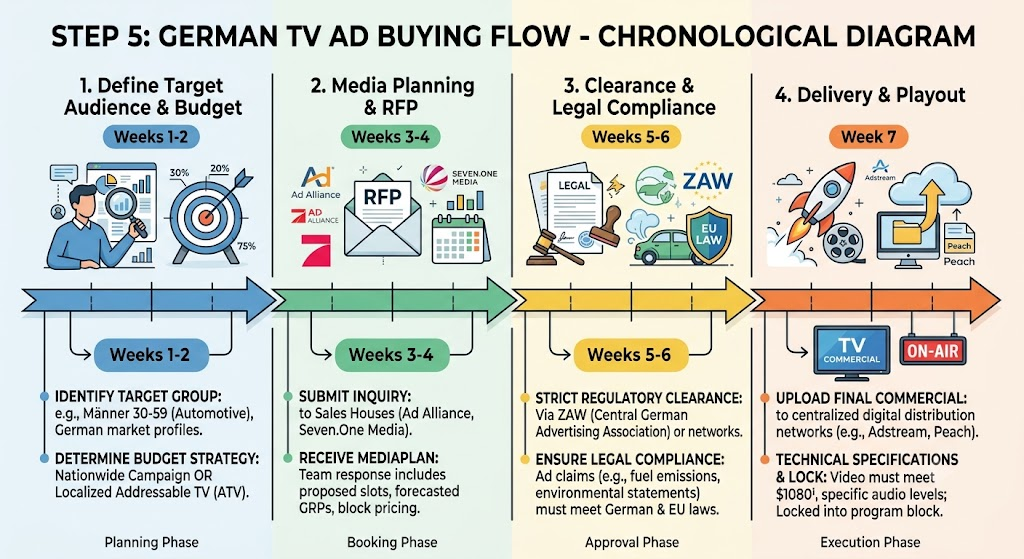
Step 5: The Step-by-Step Buying Flow
1.Define Target Audience & Budget:Weeks 1-2.
Identify your target group based on German market profiles (e.g., Männer 30-59 for automotive). Determine if your budget supports a nationwide broad campaign or a localized Addressable TV campaign.
2.Media Planning & RFP:Weeks 3-4.
Submit an inquiry to Ad Alliance or Seven.One Media. Their teams will send back a Mediaplan mapping out proposed ad slots, forecasted GRPs, and block pricing.
3.Clearance & Legal Compliance:Weeks 5-6.
In Germany, all broadcast ads must pass strict regulatory clearance via the ZAW (Central German Advertising Association) or the networks’ legal compliance teams. This ensures your automotive claims (e.g., fuel emissions, environmental statements) comply with strict EU and German laws.
4.Delivery & Playout:Week 7.
Upload the final produced commercial to a centralized digital distribution network like Adstream or Peach. The video must meet strict broadcast technical specifications ($1080\text{i}$, specific audio loudness levels). The sales house then locks it into the program block.