
In SEO, a Zero-Click Search happens when a user types a query into a search engine, finds the answer right there on the results page, and leaves without clicking on any website links.
Historically, this happened for simple things like checking the weather or converting currencies. However, with the explosion of AI Overviews and rich search engine result page (SERP) features, zero-click searches have turned into a massive structural shift. Data indicates that between 60% and 70% of all Google searches now end without a single click, particularly on mobile.
While this sounds like bad news for organic traffic, it has completely changed the rules of the game. SEO is transitioning from a “traffic-only” play to an “information and brand visibility” play.
What Triggers Zero-Click Behavior?
Google relies on several dynamic features to answer users instantly:
- AI Overviews: AI synthesizes an answer pulled from multiple websites into a conversational paragraph right at the top of the screen.
- Featured Snippets: The classic “Position Zero” text box that pulls a direct definition, list, or table from a site.
- Knowledge Panels: The data boxes on the right side of the screen providing instant facts about public figures, brands, or places.
- People Also Ask (PAA): Dropdown accordions that answer related questions inline.
- Local Packs: Map and business listings that give users phone numbers and hours instantly, bypassing the company website.
How SEOs Are Adapting (The Playbook)
If users aren’t clicking through to your blog, how do you win? The strategy shifts from trying to hoard traffic to focusing on brand authority and AI citation.
1. Optimize for “AIO” (AI Overview) Citations
AI engines and search bots need to quickly parse your data to use it as a source.
- Answer-First Structure: Put a clear, 1-2 sentence direct answer in your very first paragraph, then follow up with deeper context.
- High Fact Density: Fill your content with proprietary data, unique case studies, and original statistics. AI cannot easily copy or synthesize unique, firsthand experiments from other places, making your site a primary source.
2. Double Down on Structured Data (Schema Markup)
By using heavy JSON-LD schema (Product, FAQ, Organization, LocalBusiness), you speak the search engine’s backend language natively. It explicitly tells the algorithm what your content means, making it highly eligible for rich results and accurate AI extraction.
3. Build a “Click-Resilient” Keyword Strategy
Segment your content based on search intent.
- Accept Zero-Click for Top-of-Funnel: “What is…” or “Definition of…” keywords are going to lose traffic. Treat these purely as brand-awareness plays where your goal is just to have your logo or name cited in the AI block.
- Target Bottom-of-Funnel (BOFU): Focus heavily on high-intent keywords that require a click. Users looking for “best CRM software pricing tool” or “buy leather boots near me” almost always click through to interact, buy, or use a tool.
4. Pivot to “Search Everywhere” Optimization
Since traditional search engine traffic is deflating, smart brands look to build visibility on platforms where users actively explore, such as YouTube (which is heavily cited by Google’s AI), TikTok, vertical directories, and email newsletters.
The Takeaway: Zero-click isn’t killing SEO; it’s forcing it to mature. Success is no longer just measured by website sessions, but by share of voice—ensuring that when an AI or search engine answers a user’s question, it uses your brand to do it.
The Content Strategy
When people in SEO talk about optimizing for AI Overviews (AIO) or Gemini, they don’t mean changing what you write—they mean changing how you format it so the LLM’s “scraper” can easily slice out a snippet and cite you.
This specific approach is called “Atomic Content Strategy” or Generative Engine Optimization (GEO). Instead of writing long, flowing essays, you design your pages to be a collection of modular, bite-sized answers.
The “Atomic” Content Blueprint
To ensure Gemini or Google AIO can easily clip your content into an overview, your articles should look like a series of distinct data blocks.
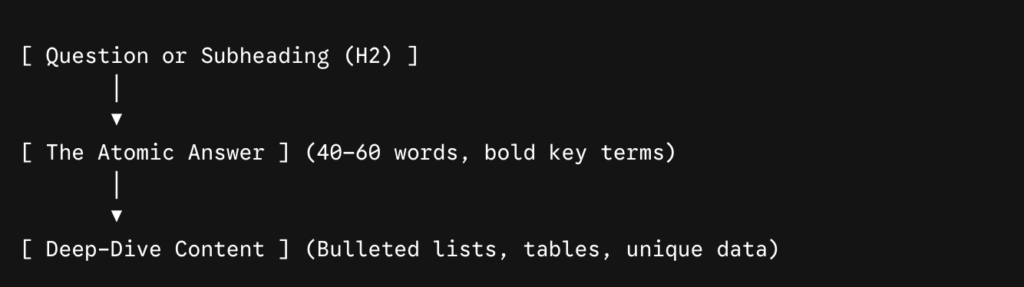
1. The “Atomic Answer” Block
Right under an H2 or H3 heading, write a direct, concise 40-to-60-word paragraph that completely answers the question. Avoid fluff or introductory phrases (e.g., instead of writing “It is important to understand that…” just state the fact). AI models love pulling these standalone sentences directly into summary boxes.
2. Formatted List Blocks
AI Overviews rely heavily on bulleted or numbered lists because they are easy to display on mobile screens. If you are explaining a process, comparison, or set of features, always use formatting over prose:
- Use bold text at the start of a bullet point to give the AI a clear anchor.
- Keep list items short and punchy.
3. Data Tables for Direct Comparison
If someone searches for a comparison (e.g., Cost of Living in Berlin vs. Munich), an AI Overview will frequently pull a Markdown table directly from a site rather than attempting to generate its own from paragraphs of text.
Why This Strategy Works (Under the Hood)
Google’s system conducts dozens of mini-searches simultaneously to build an AI Overview, and it pulls heavily from the top 10 organic search results. When its web crawler reads a page, it looks for sections with high Information Gain (new, unique statistics or direct quotes) that are cleanly wrapped in semantic HTML (like <p>, <ul>, or <table>).
By building your content strategy around these snippet-ready blocks, you give the algorithm exactly what it needs to select your site as a trusted, cited source at the top of the page.