Executive Summary
In hyper-competitive, highly regulated markets such as health, dental, and pet insurance, speed of insight directly correlates with market share protection and product profitability. Modern competitor monitoring architectures—demonstrating automated AI multi-agent workflows—represent a paradigm shift in how insurance organizations process, structure, and act upon market signals.
By employing AI agents to continuously scan, summarize, and visualize complex tariff launches (such as Zahnzusatzversicherung updates), insurers can dramatically reduce cognitive load while accelerating strategic execution across product design, brand defense, and sales enablement.
In my previous post I explained why a clear architecture and clear roles are the key to running a team of AI agents. This post shows what that looks like in practice.
See It in Action: The Agentx Demo
I’ve published a read-only demo so you can explore it yourself: Agentx demo. It’s a delayed snapshot that contains news facts only.
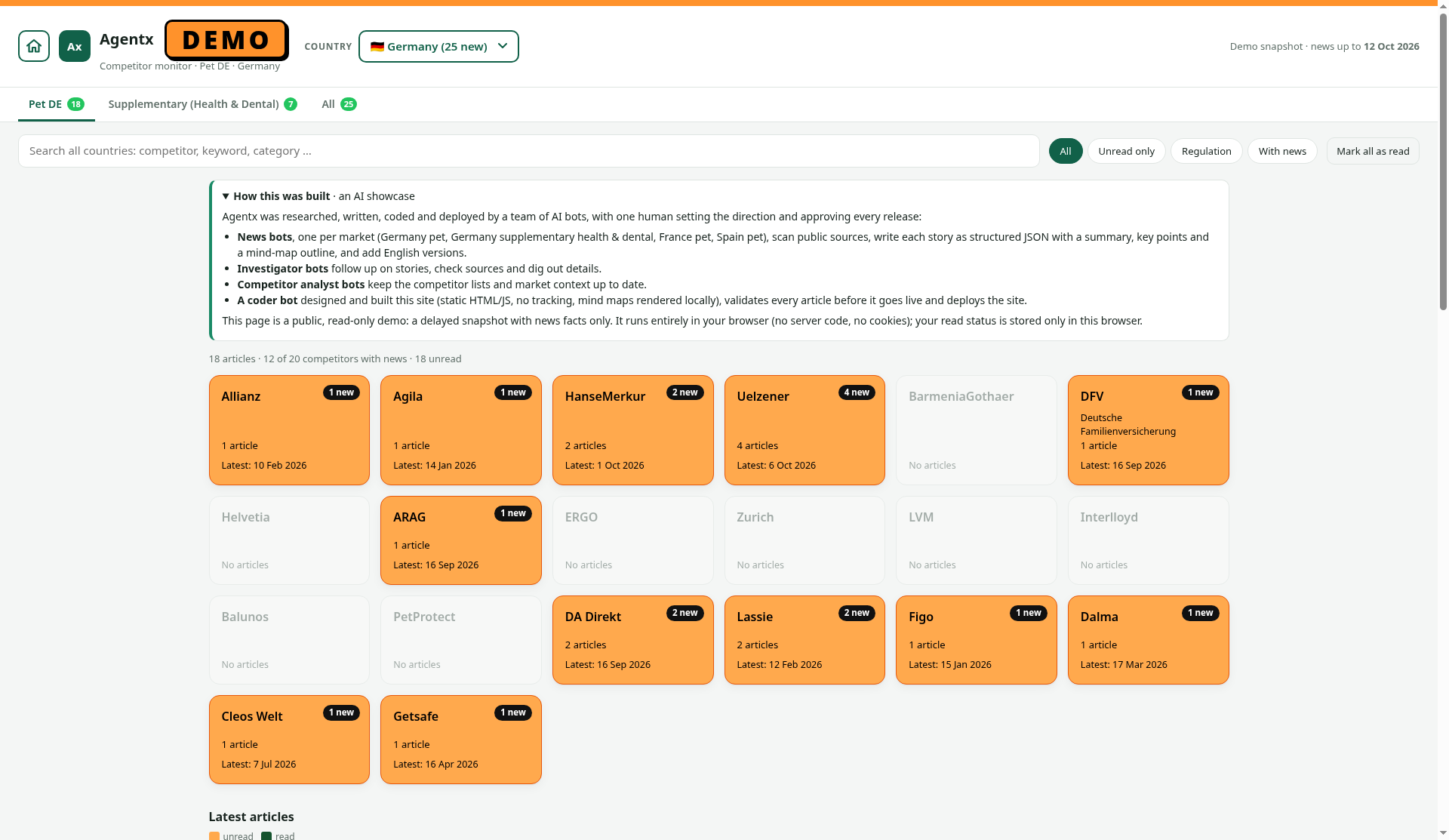
Step 1: The overview. Each tile represents a competitor. Orange tiles have new articles, so you can see at a glance where something is happening in the market.
Step 2: Click a tile. You’ll see more information about that competitor, including all its latest news with a short summary. Here’s an example.
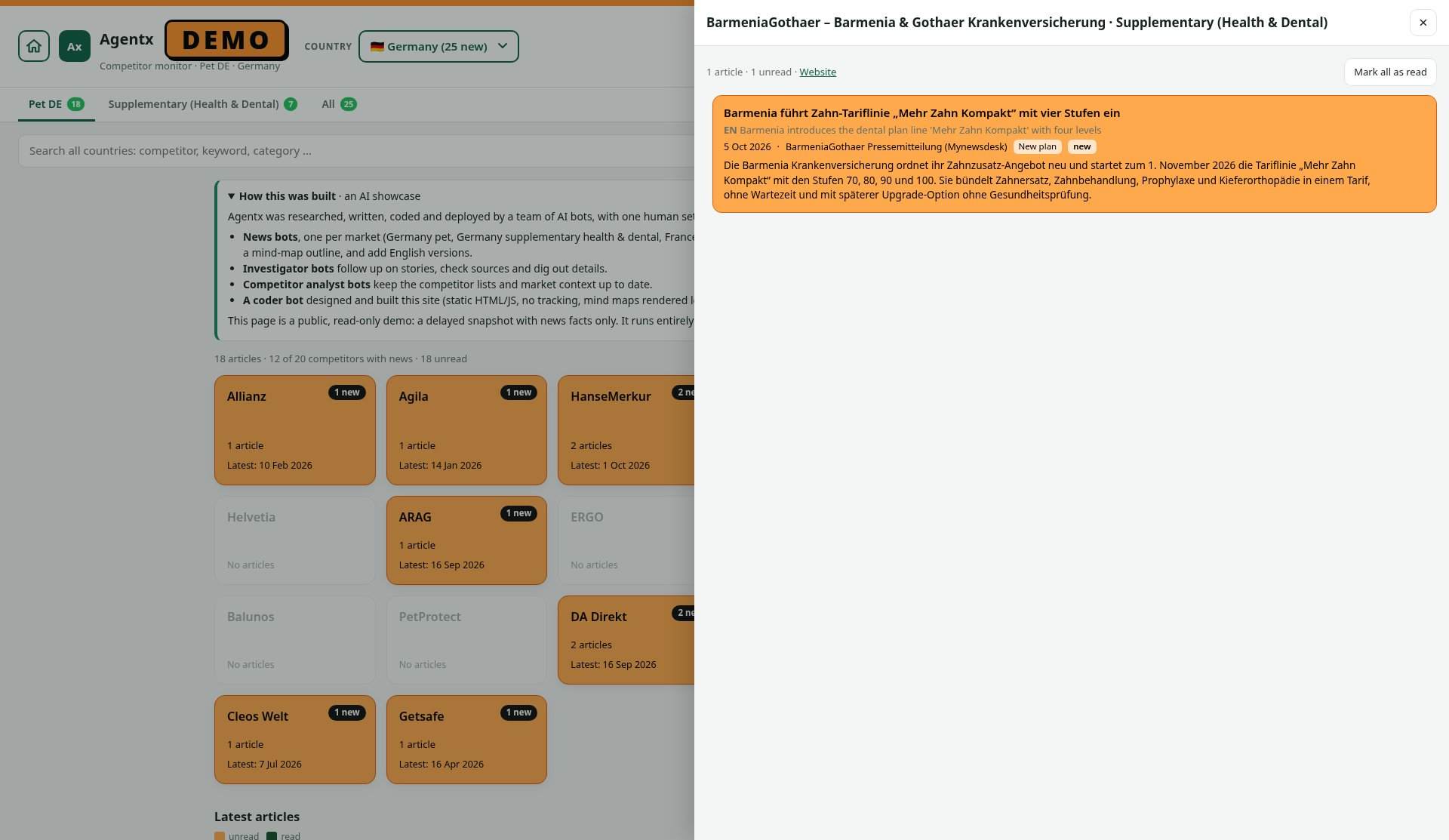
Step 3: Click the news item. You’ll get the full picture: a summary, the key points, a link to the original source and a mind map. Here’s an example. The mind map lays out the most important points visually, which makes the information much faster to understand, so you can act on it quickly.
Key Benefits of AI Automation in Capturing Competitor Data
1. Structure & Rapid Processing (High Density, Low Cognitive Load)
- Distilling Complex Tariffs: Insurance announcements are typically buried across lengthy press releases, regulatory filings, or dense terms and conditions (e.g., waiting period mechanics, Zahnstaffel reimbursement caps, and coverage exclusions).
- Automated Data Structuring: AI agent pipelines convert unstructured market news into standardized JSON formats, executive bullet points, and interactive visual mind maps.
- Instant Comprehension: Product managers and decision-makers can digest complex competitor moves in seconds rather than spending hours sifting through raw documentation.
2. Competitive Product Development & Pricing Agility
- Spotting Coverage and Pricing Gaps: Real-time extraction of competitor product tiers, reimbursement scaling, and entry pricing allows actuarial and product design teams to instantly identify market opportunities or vulnerabilities.
- Accelerating Iteration Cycles: Product development in insurance traditionally suffers from long analysis cycles. Automated intelligence feeds shorten the research phase, allowing product teams to refine counter-offerings and adapt tariffs far faster.
3. Brand Protection & Performance Marketing Defense
- Targeted Counter-Messaging: When competitors launch major promotional pushes or new tariff lines, consumer search intent spikes around comparison queries. Immediate AI-driven notification enables performance marketing teams to rapidly launch search engine defense campaigns and comparison landing pages highlighting competitive strengths.
- Proactive Reputation Guardrails: Rapid visibility into competitor compliance issues, regulatory changes, or shifts in coverage terms allows marketing and communications teams to reinforce their own brand’s transparency and value positioning.
4. Sales Enablement & Broker Distribution Support
- Real-Time Cheat Sheets for Brokers: Independent brokers (Makler) continuously shift recommendations toward attractive new market tariffs. Automated mind-map summaries equip internal sales teams with instant comparative analysis, ensuring field reps can address broker inquiries before market share is lost.
- Categorized Sector Feeds: Segmenting intelligence into distinct verticals (such as supplementary health vs. pet health) filters out noise and delivers actionable insights directly to the relevant line-of-business managers.
Conclusion
An AI-driven intelligence architecture transforms passive news consumption into an active strategic asset. By combining automated monitoring with structured visual outputs, insurance organizations gain a decisive edge—protecting their brand equity, supporting distribution channels, and delivering market-leading products ahead of the competition.
Try it yourself: explore the Agentx demo.