
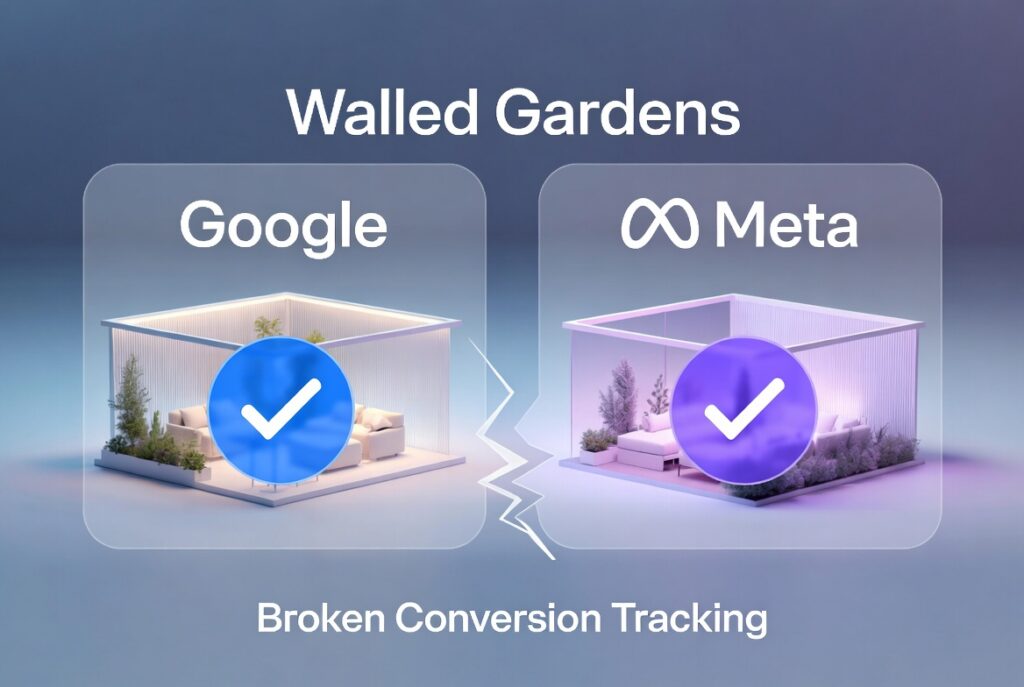
In digital advertising, a walled garden is an ecosystem where the platform operator has total control over the user data, the ad tech, and the performance reporting. They allow you to buy ads, but they do not let you export the raw user-level data outside of their “walls.”
You have to trust the data they give you inside their dashboard.
The two biggest walled gardens in marketing are Google (Paid Search/PPC) and Meta (Social Media—Facebook & Instagram). They handle data and cross-platform tracking completely differently, which explains why social media often yields a higher, more frustrating Cost Per Acquisition (CPA) compared to PPC.
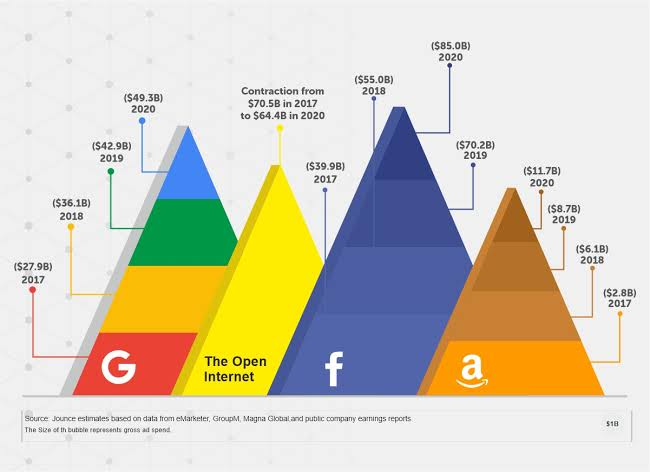
The Open Web vs. Walled Gardens
To understand the problem, look at how massive tech monopolies dominate ad spend compared to independent websites:

1. Google PPC (Paid Search): The High-Intent Garden
Google dominates search intent. Because people use Google to actively look for answers, tracking them down the funnel has historically been much more linear.
- How data works inside this garden: When a user types a query like “best lease deals near me,” they have immediate intent. They click your text ad, land on your website, and fill out a lead form.
- Why it feels easier to measure: Because the conversion happens directly on your website after a deliberate keyword search, the link between the click and the action is tightly knit. Even inside Google’s garden, it’s easier to verify that a Paid Search click led to a direct sale.
2. Meta (Facebook & Instagram): The Passive-Browsing Garden
Meta relies on user identity, interests, and behavior. Nobody logs onto Instagram to buy a car; they log on to look at photos, reels, and updates.
- How data works inside this garden: Meta tracks users meticulously inside its own apps. It knows exactly what type of car videos a user pauses on. When you run an ad, Meta targets that specific identity profile.
- The Tracking Blindspot: The trouble starts the moment a user clicks your Instagram ad and leaves the app to visit your website. Since Apple introduced iOS 14.5 (allowing users to block app tracking), Meta’s ability to “see” what that user does on your third-party website has been severely broken.
Why Walled Gardens Pit PPC against Social Media (The Attribution War)
Because Google and Meta do not share user data with one another, they both try to take 100% of the credit for the exact same sale. This creates massive headaches for determining an accurate CPA.
Imagine a typical 3-step customer journey for someone buying a car:
Step 1: User sees a beautiful video ad of an SUV on Instagram. They don’t click, but they watch it.
Step 2: Two days later, they remember the SUV, go to Google, and search for the local dealership (PPC).
Step 3: They click the Google PPC ad, visit the site, and submit a lead form.
The Measurement Discrepancy:
- Meta’s Dashboard says: “Our Instagram ad worked! We deserve credit for a view-through conversion.” Meta counts this as a win, driving down your apparent “Social CPA” inside its platform.
- Google’s Dashboard says: “Our Search ad caught them! We deserve credit for a last-click conversion.” Google counts this as a win inside its own platform.
- Your CRM / Analytics says: You only sold one car, but your ad dashboards claim you sold two.
Because Meta’s walled garden forces it to rely heavily on statistical modeling and “view-through” data (claiming credit just because someone saw an ad), its reported data often looks vastly inflated.
When you strip away the platforms’ self-reported dashboards and look strictly at hard CRM data (actual store leads), Meta’s real, verified direct CPA regularly outpaces PPC. This is exactly why, as you noted, relying on social media for direct-response lead generation usually costs more than catching a buyer who is actively searching on Google.