
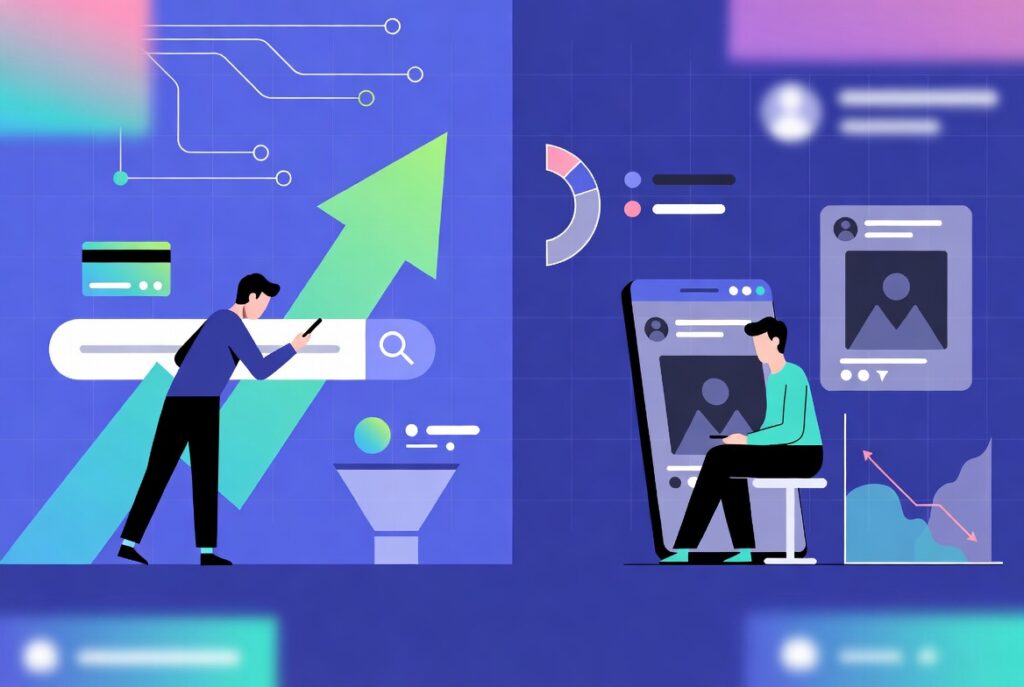
Social Media Marketing and Cost Attribution
Is heavy investment in Paid Social justifiable for marketing outside of brand awareness? Because of ‘walled gardens’ in data analytics, tracking an accurate CPA is highly complex, and visible CPAs for Facebook and Instagram consistently outpace PPC. I typically advise scaling back social ad spend for this reason—do you agree, or are there attribution frameworks that prove otherwise ?
The “Intent Gap” (Why PPC Wins hands down)
The core reason PPC (Google Search, Google Shopping, Bing) outclasses Social Media in automotive is search intent.
- PPC: When someone types “used Volkswagen Golf automatic Berlin” into Google, they have a credit card in hand and a high intent to buy. You are paying for a highly qualified lead at the exact moment of decision.
- Social Media: People go to Instagram and Facebook to look at memes, vacation photos, or news. When you show them a car ad, you are interrupting them. Even if they click because the car looks nice, they are usually months away from actually buying.
2. The Walled Garden & Attribution Nightmare
The attribution problem. Ever since Apple’s iOS 14 update and the ongoing death of third-party cookies, Meta’s (Facebook/Instagram) tracking pixel is notoriously unreliable for high-ticket items ( Customers don’t just click “buy now.” They require a much longer deliberation period, extensive research, and a high level of trust in the brand before purchasing high cost products ).
- Meta loves to claim “View-Through Conversions” (e.g., “This user bought a car on your website, and they happened to scroll past our Instagram ad 6 days ago, so give Meta the credit!”).
- In reality, if we look at the internal CRM or Google Analytics, that customer almost always came through Direct traffic, organic search, or a Google PPC ad. Meta’s Cost Per Acquisition (CPA) often looks artificially cheap in their own dashboard, but when you look at bank-account-level data, the real CPA is sky-high compared to PPC.
3. When Should Brands Use Social Media?
If the conversion CPA is so bad, why do companies still spend millions on Meta? Let’s have a look at an example from the automotive industry, they use it strictly for two specific use cases:
- Top-of-Funnel Branding (Trust Building): Buying a car online is terrifying for most people. Social media is great for showing video testimonials, behind-the-scenes vehicle inspections, and influencer reviews. It doesn’t sell the car today, but it makes the user trust the brand so that three weeks later, when they search on Google PPC, they click your ad instead of a competitor’s.
- Dynamic Retargeting (The Only Direct-Response Exception): If a user goes to the car seller website, looks at a specific 2022 BMW 3-Series, and leaves, using Meta to show that exact car to them on their Instagram feed the next day actually has a very strong ROI.
The Verdict for Budget Attribution
If your goal is short-term sales volume at the lowest possible CPA, the strategy should be:
- Max out your PPC search budget first. Do not leave any high-intent Google search demand on the table.
- Move Social Media strictly to a “Retargeting & Branding” bucket. Cap your social media spend at a small percentage of your total budget (e.g., 10–15%) just to keep your retargeting ads alive and maintain brand presence.
If a marketing agency or team member tries to push for a massive Facebook/Instagram prospecting budget, demand that they prove the CPA using a closed-loop CRM match (matching actual car sales data to Meta user IDs) rather than relying on Meta’s flawed dashboard metrics.